Android a les parts de marché, iOS a les profits

Android est loin devant Apple en terme de part de marché. 88% pour Android ! Cependant, les smartphones Android semblent être moins aptes à la navigation sur internet (ou alors le public qui les achète y va moins), car autant les parts de marchés en terme de vente de smartphones neufs sont clairement à l’avantage d’Android, alors que celle de la navigation sont beaucoup moins claires… Comme si les utilisateurs de smartphones iOS allaient beaucoup plus sur internet que ceux d’Android.

De plus, apparemment les profits dans le monde Android sont extrêmement faibles. En témoigne un article dans investors.com :

Apple’s smartphone market share by unit shipments is declining, but it continues to dominate where it counts: profits.

BMO Capital Markets analyst Tim Long estimates that Apple accounted for 103.6% of smartphone industry operating profits in the third quarter. Its share is over 100% because other vendors lost money in the business, resulting in Apple having more smartphone profit than the industry netted overall. In the year-earlier period, Apple grabbed 90% of smartphone profits, Long said in a research report Thursday.

Apple was No. 1 by a mile in smartphone operating profit in Q3. Among major vendors, Samsung was No. 2 in smartphone profits with a tiny 0.9% share, he said. Money-losers in the smartphone business last quarter included LG and HTC, Long said.
D'après IBM, les macs sont moins chers en entreprise que les PC (de 535$ exactement)

D’après un article de Jamf :

In 2015, IBM let their employees decide — Windows or Mac. “The goal was to deliver a great employee choice program and strive to achieve the best Mac program,” Previn said. An emerging favorite meant the deployment of 30,000 Macs over the course of the year. But that number has grown. With more employees choosing Mac than ever before, the company now has 90,000 deployed (with only five admins supporting them), making it the largest Mac deployment on earth.

But isn’t it expensive, and doesn’t it overload IT? No. IBM found that not only do PCs drive twice the amount of support calls, they’re also three times more expensive. That’s right, depending on the model, IBM is saving anywhere from $273 - $543 per Mac compared to a PC, over a four-year lifespan. “And this reflects the best pricing we’ve ever gotten from Microsoft,” Previn said. Multiply that number by the 100,000+ Macs IBM expects to have deployed by the end of the year, and we’re talking some serious savings.

We only produce crap software

*Nous ne produisons que du code informatique de merde.

Tiré d’une partie d’un billet de Daring Fireball :

And it is! Here’s Dave Winer from all the way back in 1995:

An old software slogan at Living Videotext: “We Make Shitty Software… With Bugs!” It makes me laugh! We never ran this slogan in an ad. People wouldn’t understand. But it’s the truth. We make shitty software. And so do you!

Software is a process, it’s never finished, it’s always evolving. That’s its nature. We know our software sucks. But it’s shipping! Next time we’ll do better, but even then it will be shitty. The only software that’s perfect is one you’re dreaming about. Real software crashes, loses data, is hard to learn and hard to use. But it’s a process. We’ll make it less shitty. Just watch!

Software, in general, is much better than it used to be. Unlike 1995, we don’t lose data due to bugs very often. (For me personally, I can’t even remember the last time I lost data.) But our hardware is so much better than our software, the contrast is jarring.

En fait, Samsung avait accéléré le lancement des Note 7

Samsung voyant, environ un mois avant la sortie des nouveaux iPhones 7, que ceux-ci n’auraient pas énormément de nouvelles fonctionnalités visibles, la marque sud-coréennes a accéléré la sortie du Note 7 en mettant la pression sur ses fournisseurs pour qu’ils mettent le paquet… On sait comment ça s’est fini (les batteries qui explosent).

Yoolim Lee et Min Jeong Lee, pour Bloomberg:

Few things motivate Samsung employees like the opportunity to take advantage of weakness at Apple Inc.

Earlier this year, managers at the South Korean company began hearing the next iPhone wouldn’t have any eye-popping innovations. The device would look just like the previous two models too. It sounded like a potential opening for Samsung to leap ahead.

So the top brass at Samsung Electronics Co., including phone chief D.J. Koh, decided to accelerate the launch of a new phone they were confident would dazzle consumers and capitalize on the opportunity, according to people familiar with the matter. They pushed suppliers to meet tighter deadlines, despite loads of new features, another person with direct knowledge said. The Note 7 would have a high-resolution screen that wraps around the edges, iris-recognition security and a more powerful, faster-charging battery. Apple’s taunts that Samsung was a copycat would be silenced for good.

Quelques embûches pour la sortie de l'iPhone 7

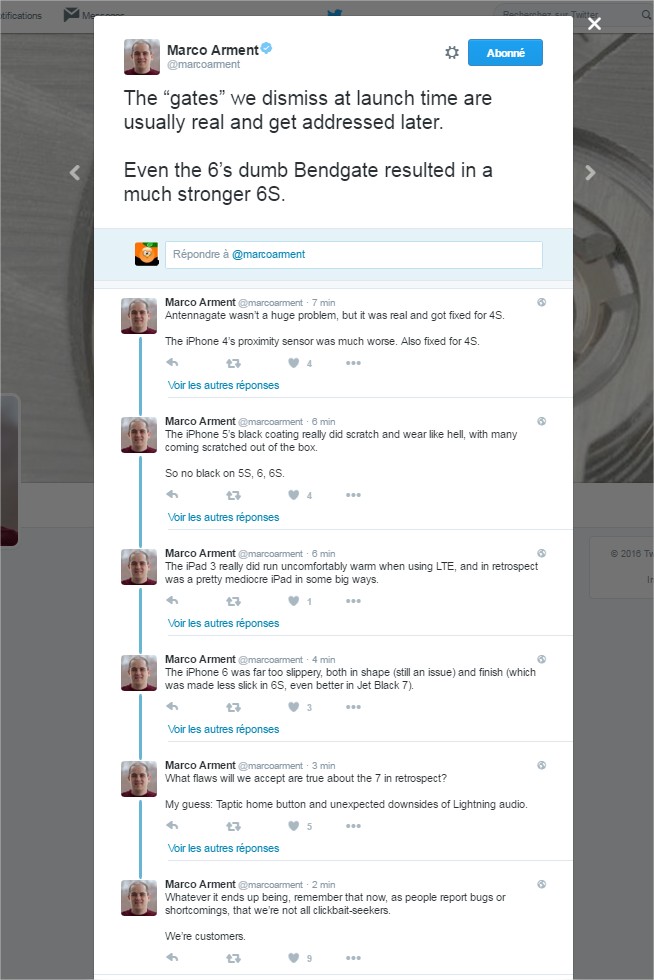
Plusieurs petits obstacles sont venus se mettre en travers de la route de l’iPhone 7. D’abord le fait que le Home Button semble ne fonctionner qu’avec la peau humaine (et surtout mal fonctionner avec des gants par exemple), ce qui est vite assez gênant. Apparemment, en utilisant des gants capacitifs, ça fonctionne mieux.

Mais pire à mes yeux : iOS 10 semble avoir de sérieux bugs. Notamment celui du non redimensionnement correct des mails non responsive, cf ce thread là, où un des développeurs de l’appli Mail d’Apple dit qu’ils sont au courant du problème et qu’ils bossent dessus.

Samsung aurait du rappeler les Note 7 beaucoup plus tôt

Apparemment, d’après le Wall Street Journal, Samsung a pris bizarrement un peu de retard dans son rappel des Note 7. Ils auraient du se mettre d’accord avec le CPSC aux USA afin d’organiser conjointement ce rappel (ce qui n’a pas été fait avant une semaine). Or, justement c’est ça qui pose problème, d’habitude tout le monde passe d’abord par le CSPC :

In announcing the recall, however, experts say, the South Korean company neglected to first coordinate with safety authorities in the U.S. According to U.S. law, the CPSC must be notified within 24 hours after a safety risk has been identified, and recall announcements are generally then carried out jointly.

The U.S. agency didn’t issue a statement until Sept. 9, a week after Samsung’s initial announcement.

“This is completely unusual; companies just don’t issue recalls without the CPSC,” says Pamela Gilbert, a partner with Washington’s Cuneo Gilbert & LaDuca LLP and a former executive director of the CPSC.